

Recent Analysis Shows Racial Disparities in Depression Treatment

July 11, 2022

By Julie Sonier, MNCM President

I recently came across an interesting report on racial disparities in depression treatment by the Blue Cross Blue Shield Association. Published in May 2022, I found this report noteworthy for several reasons. 

First, it directly addresses two topics that have been much in the news and the focus of attention from health care stakeholders of all types in the last couple of years: mental health, and racial disparities in health and health care. Both topics have taken on increased urgency considering the COVID-19 pandemic and the increased attention to racial disparities and racial justice since the murder of George Floyd in Minneapolis in May 2020. 

Second, several of the findings are quite striking. The analysis suggests that major depression is likely significantly underdiagnosed in Black and Hispanic communities, especially in communities where there were fewer behavioral health care providers. Among those who do receive a diagnosis, the analysis showed disparities in treatment of depression, for both prescription drug treatment and counseling. 

Third, there are substantial data limitations and hurdles that must be overcome to better understand and act on disparities. For this analysis, race/ethnicity was estimated based on the majority race/ethnicity among households by zip code. Given the data limitations and the urgent need for improved understanding of disparities, this approach represents a creative solution – but it is far from perfect and highlights the urgent need for better information if we are to make progress in improving health equity. 

Though not directly comparable to the data analyzed in the Blue Cross Blue Shield Association study, the data on depression outcomes collected by MNCM also show disparities by race and ethnicity, as well as language and country of origin (RELC). In May, we published our annual report on disparities in quality metrics by RELC using data collected in 2021 (largely reflecting 2020 dates of service). Among adults diagnosed with depression, rates of remission at six months for Black, Hispanic/Latinx, and Indigenous Minnesotans were well below the statewide average (at 59 percent, 72 percent, and 73 percent of the statewide average, respectively). 

MNCM is frequently sought out as a national leader in the collection of high-quality, comprehensive data on RELC that we use to understand disparities in care and health outcomes. We are proud of the collective work of our entire community to get to this point but know that there is so much more that needs to be done – related to improving the availability and reliability of data, but also in how data are leveraged to drive knowledge and action.  

Given MNCM’s focus on data to drive improvement, we are interested in hearing your stories about using the data for improvement in health and health equity. We also seek to partner with researchers, health care stakeholders, government agencies, and others on leveraging data in ways that generate insights and action.  Please email us at support@mncm.org to find out more about potential ways to partner with MNCM on leveraging data or to share your stories of data-driven strategies for improvement in health care quality and health equity. 


Posted in Blog

Recent Posts

By Liz Cinqueonce, MBA October 30, 2025
By Liz Cinqueonce, MBAPresident & CEO of MNCM At MN Community Measurement (MNCM), we believe that the most meaningful progress in health care comes when the community is at the center—when those closest to the work and most affected by outcomes help shape the path forward. Building on this foundation, we are making interoperability a… The post Community at the Helm: Interoperability as a Priority for Minnesota’s Health Data appeared first on MN Community Measurement.

By Jess Donovan, MPH, BSN October 21, 2025
This October marks the 40th anniversary of Breast Cancer Awareness Month. According to the American Cancer Society, about 1 in 8 women will be diagnosed with invasive breast cancer in their lifetime. Fortunately, however, early detection through screening and advances in treatment have decreased mortality by 44% since 1989. Screening can catch cancer early, when it is… The post Empowered by Data: Uncovering Screening Disparities and Reducing Breast Cancer Risk appeared first on MN Community Measurement.

By Jess Donovan, MPH, BSN September 30, 2025
September is Sexual Health Awareness Month. As we close out September, we’re highlighting two of the measures we report on – Cervical Cancer Screening and Chlamydia Screening in Women.   Cervical cancer, once one of the most common cancers affecting women in the United States, has significantly decreased since the 1970s. The reason for the decline… The post Empowered by Data: Spotlight on Screening for Sexual Health appeared first on MN Community Measurement.

By Liz Cinqueonce, MBA September 25, 2025
"It feels like.." The post Elevating Local Voices: Insights from MNCM’s Regional Community Conversations appeared first on MN Community Measurement.
By Jess Donovan, MPH, BSN August 20, 2025
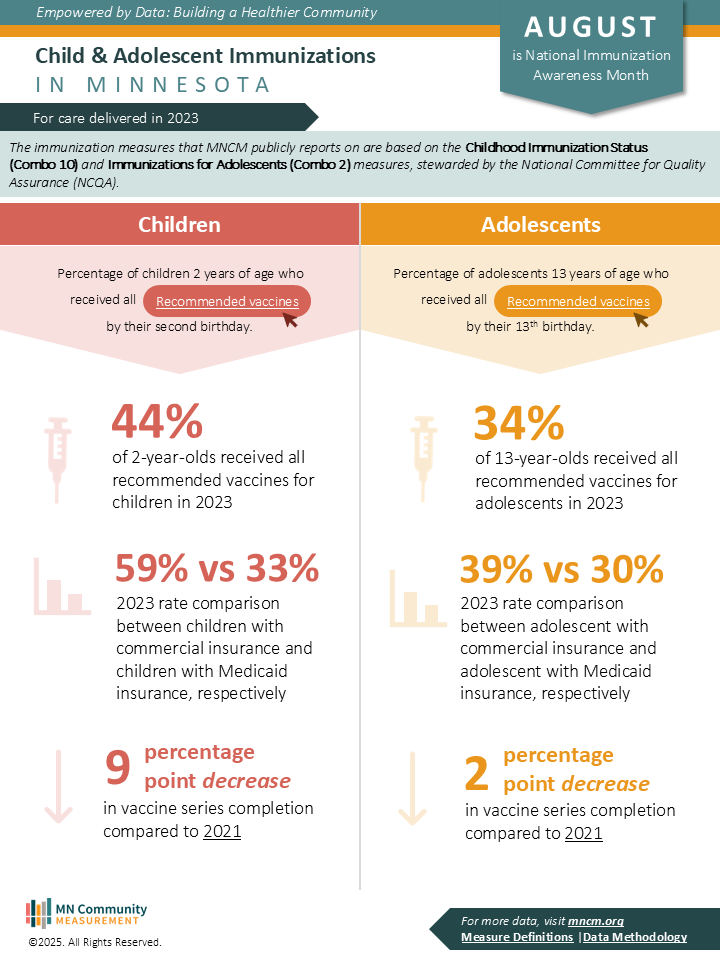
By Jess Donovan, MPH, Clinical Measurement Analyst, MN Community Measurement; and Steven Inman, MD, Medical Director, Children’s Health Network August is National Immunization Awareness Month. Vaccines are a safe and effective way to protect both individuals and communities from serious and preventable illnesses like measles, tetanus, diphtheria, and influenza. However, the health of the community… The post Empowered by Data: Uncovering Immunization Gaps in Children and Adolescents appeared first on MN Community Measurement.
Recent Comments

Archives

Categories